

When an owner needs additional capacity, new infrastructure, or a major facility upgrade, one of the earliest strategic questions may be whether to modify an existing site or develop something new.
At first glance, the distinction seems straightforward.
A brownfield project works within an existing facility or infrastructure system. A greenfield project starts largely from a new site and new infrastructure.
In practice, however, the choice affects much more than location.
It changes how engineers approach site information, design criteria, utility capacity, equipment interfaces, construction access, permitting, shutdowns, project risk, cost certainty, scheduling, and future expansion.
A brownfield project may benefit from existing buildings, utilities, roads, equipment, and operating infrastructure, but those same assets can create significant constraints.
A greenfield project provides greater freedom to optimize the facility from the beginning, but the project may need to develop nearly everything from site servicing to utilities and supporting infrastructure.
Neither approach is inherently better.
The right choice depends on what already exists, what the project needs to achieve, the condition and capacity of existing assets, operational requirements, project economics, risk tolerance, and long-term plans.
What Is a Brownfield Project?
A brownfield engineering project involves modifying, expanding, rehabilitating, or integrating new work into an existing facility, site, or infrastructure system.
Typical brownfield projects may include:
- Industrial facility expansions
- Plant upgrades
- Equipment replacement
- Capacity increases
- Debottlenecking
- Structural modifications
- Utility upgrades
- Process system changes
- Mine infrastructure modifications
- Road rehabilitation
- Existing water or wastewater infrastructure upgrades
The defining characteristic is not simply the age of the site.
It is the need to design new work around existing assets, systems, operations, and constraints.
This distinction is important because the term “brownfield” can also refer to previously developed or potentially contaminated land in environmental and real-estate contexts.
In engineering projects, brownfield commonly refers more broadly to work involving an existing facility or operating asset.
The project team therefore needs to understand both the new requirements and the existing conditions into which those requirements must be integrated.
What Is a Greenfield Project?
A greenfield engineering project involves developing a new facility, site, or infrastructure system without the same level of constraint from existing operating assets.
Examples may include:
- A new industrial plant
- A new processing facility
- New mine infrastructure
- A new energy facility
- A new road or transportation system
- New water or wastewater infrastructure
- A new utility network
- A new industrial development
Greenfield projects usually provide greater freedom to optimize:
- Site layout
- Equipment arrangement
- Utility systems
- Building locations
- Roads and access
- Drainage
- Construction sequencing
- Maintenance access
- Future expansion
That flexibility does not make the project simple.
Greenfield development may require new access roads, power, water, drainage, communications, permitting, environmental work, site preparation, and other infrastructure before the primary facility can operate.
The challenge is different rather than necessarily smaller.
Brownfield vs. Greenfield Projects at a Glance
The following comparison highlights some of the most common differences.
| Factor | Brownfield Project | Greenfield Project |
|---|---|---|
| Existing Assets | Major part of the design environment | Limited or none |
| Design Freedom | More constrained | Generally higher |
| Existing Documentation | May be incomplete or outdated | Developed as part of the project |
| Field Verification | Often critical | Usually focused on site conditions |
| Tie-ins | Common | Typically fewer |
| Shutdown Requirements | May be significant | Usually limited |
| Construction Access | Often constrained | Can often be planned more freely |
| Utility Capacity | Existing capacity must be verified | New systems can be sized for demand |
| Existing Operations | May need to continue during construction | Usually not a constraint |
| Hidden Conditions | Important project risk | Less exposure to existing-asset uncertainty |
| Future Expansion | Limited by existing site conditions | Can be incorporated early |
| Site Development | Often partly available | Usually significant |
| Construction Interfaces | Often complex | More controllable |
| Permitting | May involve modifications to existing approvals | Often requires new approvals |
These differences influence almost every stage of the Engineering Design Process.
The Biggest Engineering Difference: Existing Conditions
One of the most important differences between brownfield and greenfield projects is the role of existing conditions.
In a greenfield project, engineers primarily need to determine:
What needs to be built?
In a brownfield project, an equally important question comes first:
What actually exists?
That question can be surprisingly difficult to answer.
An operating facility may have been modified repeatedly over several decades.
Available information may include:
- Original design drawings
- As-built drawings
- Record drawings
- Previous modification packages
- Equipment documentation
- Maintenance records
- Survey information
- Operations knowledge
- Field measurements
The challenge is that these sources may not agree.
A drawing may show the original design but not a field modification completed years later.
An equipment data sheet may describe a component that has since been replaced.
Underground utilities may exist in locations different from historical records.
For this reason, existing information should often be treated as an engineering input that requires verification rather than unquestioned fact.
Depending on the project, verification may involve:
- Field measurements
- Survey
- Laser scanning
- Utility locating
- Equipment verification
- Structural investigation
- Site inspection
- Asset Condition Assessment
The earlier these uncertainties are identified, the less likely they are to create expensive redesign or construction delays later.
How Design Strategy Changes Between Brownfield and Greenfield Projects
Both project types require good engineering, but the design priorities are different.
Brownfield Design Strategy
Brownfield design usually begins with constraints.
Engineers may need to consider:
- Existing geometry
- Available utility capacity
- Existing equipment
- Structural capacity
- Tie-in locations
- Operating requirements
- Shutdown limitations
- Maintenance access
- Construction access
- Existing underground services
- Previously installed systems
- Temporary operating conditions
The engineering solution must fit into this environment.
In many cases, the technically simplest new system is not the most practical solution if it requires extensive modifications to operating infrastructure.
Greenfield Design Strategy
Greenfield design offers more opportunity to optimize the entire system.
The engineering team can consider:
- Site orientation
- Process flow
- Equipment arrangement
- Road access
- Utility routing
- Building placement
- Drainage
- Construction staging
- Maintenance access
- Future capacity
- Expansion corridors
The opportunity is to avoid creating constraints that future projects will later need to work around.
This makes early planning and a strong Basis of Design particularly valuable.
Field Verification and Site Investigation
Site investigation is important on both project types, but the questions being answered are often different.
Brownfield Field Verification
The objective is frequently to establish what is already there and whether it can support the proposed project.
Activities may include:
- Existing-condition survey
- Laser scanning
- Utility locating
- Structural condition review
- Equipment verification
- Existing capacity assessment
- Foundation investigation
- Material testing
- Field dimensions
- Review of operating systems
Field verification should focus on information that can materially influence design.
For example, confirming the actual location of underground utilities before Detailed Design may prevent major conflicts during excavation.
Greenfield Site Investigation
The project may instead require:
- Topographic survey
- Geotechnical investigation
- Environmental studies
- Drainage assessment
- Utility availability review
- Access evaluation
- Climatic data
- Land constraints
- Hydrological information
These investigations establish the physical basis for developing the new facility.
In both cases, early investigation can be an important component of Feasibility Studies and project risk reduction.
Brownfield Tie-Ins and Shutdown Requirements
Tie-ins are one of the defining challenges of many brownfield projects.
New systems may need to connect into existing:
- Piping
- Electrical distribution
- Controls
- Utilities
- Drainage
- Process systems
- Structural systems
- Communications
Some connections can be completed while the facility remains operational.
Others require a shutdown.
Shutdown requirements can become major engineering constraints.
Consider a process facility that can only stop production for 12 hours.
An engineering solution requiring a 48-hour piping shutdown may be technically straightforward but operationally unacceptable.
The shutdown duration therefore becomes part of the design criteria.
Engineers may need to consider:
- Prefabrication
- Temporary systems
- Isolation points
- Construction sequencing
- Pre-shutdown preparation
- Alternative tie-in locations
- Parallel systems
- Rapid installation methods
This is where design decisions, operations, construction planning, and Project Management become closely connected.
Construction in an Operating Facility
Brownfield construction often occurs while surrounding systems remain in service.
That changes how the project must be designed and executed.
Potential constraints include:
- Restricted access
- Active equipment
- Operating personnel
- Safety zones
- Limited laydown areas
- Existing traffic
- Live electrical systems
- Process hazards
- Temporary systems
- Noise or vibration limitations
- Limited lifting access
- Simultaneous operations
Construction sequencing may therefore influence design decisions much earlier than it would on a typical greenfield project.
An equipment replacement, for example, may need to be designed around a specific lifting path because adjacent equipment cannot be removed.
A new pipeline may need to follow a less direct route because the preferred corridor is occupied.
A structural modification may require temporary support while the existing facility remains operational.
These considerations make early constructability review and Construction Support planning particularly valuable.
How Risk Profiles Differ
Brownfield projects are sometimes described as more risky than greenfield projects.
That is too simplistic.
The risk profiles are different.
| Typical Brownfield Risks | Typical Greenfield Risks |
|---|---|
| Unknown existing conditions | Site development uncertainty |
| Incomplete historical drawings | New permitting requirements |
| Existing utility capacity | New utility availability |
| Complex tie-ins | New system commissioning |
| Shutdown limitations | Infrastructure development |
| Operational disruption | Site access development |
| Hidden deterioration | Geotechnical uncertainty |
| Interface conflicts | Large-scale coordination |
| Construction congestion | Long development schedule |
| Existing equipment limitations | New technology integration |
A brownfield project may have high uncertainty around existing conditions.
A greenfield project may have higher uncertainty around permitting, infrastructure development, site preparation, or major capital commitments.
Risk management should therefore focus on the actual project environment rather than assuming one category is automatically safer.
A structured Project Risk Register can help the project team identify, assign, and manage these uncertainties throughout the project lifecycle.
Is Brownfield Always Cheaper?
No.
Brownfield projects can benefit from infrastructure that already exists.
Potential advantages include existing:
- Land
- Roads
- Buildings
- Utilities
- Electrical infrastructure
- Process systems
- Equipment
- Site access
Reusing these assets may significantly reduce capital requirements.
However, brownfield projects can also contain costs that are difficult to identify early.
These may include:
- Demolition
- Utility relocation
- Temporary works
- Shutdowns
- Field modifications
- Existing-condition investigation
- Structural reinforcement
- Construction inefficiency
- Rework
- Restricted access
- Remediation
For example, reusing an existing building may appear less expensive than constructing a new one.
But if the building requires significant reinforcement, equipment relocation, utility upgrades, and a long production shutdown, the overall economics may change.
The relevant question is therefore not:
How much existing infrastructure can we reuse?
It is:
Does reusing this infrastructure create better overall project value?
This is where Value Engineering and lifecycle analysis can provide useful decision support.
Which Is Faster: Brownfield or Greenfield?
There is no universal answer.
A brownfield project may progress quickly if:
- Existing infrastructure has adequate capacity
- Modification scope is limited
- Site information is reliable
- Shutdowns are manageable
- Tie-ins are straightforward
- Permits can be amended efficiently
But brownfield schedules can become difficult when:
- Existing conditions are unknown
- Field verification occurs late
- Shutdown windows are limited
- Tie-ins are complex
- Existing structures require reinforcement
- Operations restrict construction access
Greenfield projects may require more work before construction begins.
Potential schedule drivers include:
- Land development
- Environmental approvals
- New utilities
- Site servicing
- Geotechnical work
- New roads
- Major permitting
- New infrastructure
However, once the site and approvals are ready, construction may progress with fewer legacy constraints.
Schedule comparison should therefore evaluate the complete project lifecycle rather than only construction duration.
Permitting and Regulatory Differences
Permitting requirements vary significantly by project, location, sector, and jurisdiction.
However, brownfield and greenfield projects can face different approval challenges.
Greenfield Projects
New development may require:
- Land-use approvals
- Environmental studies
- New construction permits
- Utility approvals
- Site development approvals
- Stormwater approvals
- Access approvals
- New operating permits
Because the facility is new, the project may need to establish an entirely new regulatory basis.
Brownfield Projects
Existing facilities may already operate under permits and approvals.
The project may need to determine whether proposed modifications require:
- Permit amendments
- Updated environmental approvals
- Revised operating conditions
- Changes to utility agreements
- New building permits
- Process approval changes
Existing contamination or historical site conditions may also influence the project.
Permitting should therefore be considered during early project planning rather than treated as an administrative activity near construction.
Brownfield vs. Greenfield During FEED
Front-End Engineering Design (FEED) plays an important role in both project types, but the priorities differ.
Brownfield FEED
Brownfield FEED should reduce uncertainty around existing conditions and project interfaces.
Key activities may include:
- Confirming existing systems
- Establishing available capacity
- Identifying tie-ins
- Verifying site conditions
- Defining shutdown requirements
- Evaluating required modifications
- Reviewing constructability
- Identifying operational constraints
- Developing execution strategy
The objective is to avoid carrying major existing-condition uncertainty into detailed engineering.
Greenfield FEED
Greenfield FEED may focus more heavily on:
- Site layout
- Facility configuration
- Design capacity
- Utility philosophy
- Major equipment
- Infrastructure requirements
- Construction approach
- Future expansion
- Capital definition
The project has more design freedom, so early decisions can have a major impact on long-term project value.
Brownfield vs. Greenfield During Detailed Design
During Detailed Design, the difference between the two environments becomes even more visible.
Brownfield Detailed Design
Detailed engineering may need to account for:
- Verified field dimensions
- Existing equipment
- Tie-in details
- Existing structures
- Temporary conditions
- Construction sequencing
- Shutdown plans
- Access limitations
- Existing utilities
Accuracy at interfaces is critical.
A small dimensional error at an existing tie-in can create significant field rework.
Greenfield Detailed Design
Greenfield detailed engineering can focus on developing coordinated new systems without as many existing-asset constraints.
Typical priorities include:
- Integrated facility layout
- New infrastructure
- Equipment coordination
- Utility systems
- Construction-ready documentation
- Future access
- Maintenance requirements
- Expansion provisions
Greater freedom does not reduce the need for coordination.
It simply shifts the engineering problem from integration with legacy systems toward optimization of the new facility.
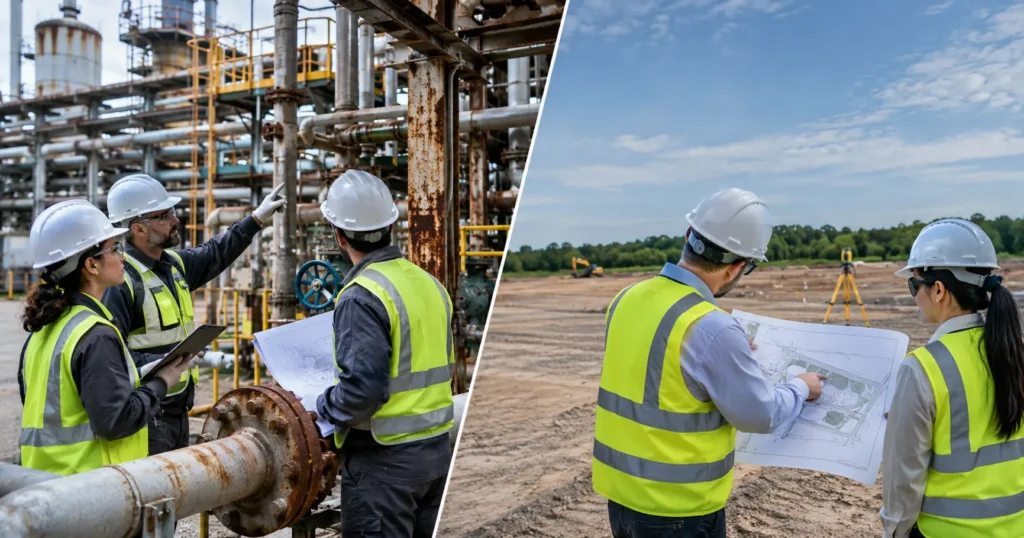
Practical Example: Expanding an Existing Industrial Facility vs. Building a New One
Consider an industrial owner that needs approximately 30% more production capacity.
Two development strategies are being considered.
Option A: Brownfield Expansion
The existing facility would remain in operation while new equipment is added.
The project could reuse:
- Existing land
- Roads
- Buildings
- Electrical supply
- Utilities
- Process infrastructure
The project would also require:
- New process tie-ins
- Equipment modifications
- Utility capacity confirmation
- Structural assessment
- Limited shutdowns
Potential advantages include:
- Reuse of existing infrastructure
- Reduced new land development
- Potentially lower initial capital cost
- Continued use of established site operations
Potential risks include:
- Existing capacity limitations
- Unknown site conditions
- Construction conflicts
- Shutdown constraints
- Limited space for future expansion
Option B: Greenfield Facility
A new facility would be constructed on a separate site.
It could be designed around:
- Optimized process flow
- New equipment
- New utility systems
- Future expansion
- Efficient construction access
- Modern operating requirements
Potential advantages include:
- Greater design flexibility
- More efficient long-term layout
- Easier construction sequencing
- Reduced disruption to existing operations
- Better provision for future expansion
Potential risks include:
- New infrastructure cost
- Permitting
- Site development
- Utility development
- Longer pre-construction timeline
Neither option can be selected intelligently based only on capital cost.
The owner needs to compare lifecycle value, operational impact, schedule, project risk, and long-term strategy.
Example Brownfield vs. Greenfield Decision Matrix
A project team may use a comparative matrix during early planning.
| Criterion | Brownfield Expansion | Greenfield Development |
|---|---|---|
| Initial Capital Cost | Potentially lower | Potentially higher |
| Existing Infrastructure Use | High | Low |
| Design Flexibility | Lower | Higher |
| Shutdown Risk | Higher | Lower |
| Unknown Existing Conditions | Higher | Lower |
| Future Expansion Flexibility | More constrained | Higher |
| New Site Development | Limited | Significant |
| Operational Disruption | Potentially high | Usually lower |
| Tie-In Complexity | High | Low |
| Construction Freedom | Lower | Higher |
| Permitting Complexity | Project-specific | Project-specific |
| Schedule Certainty | Depends heavily on existing conditions | Depends heavily on approvals and site development |
This is only an example.
The weighting of each criterion should reflect project objectives.
For one owner, uninterrupted production may be the highest priority.
For another, minimizing capital expenditure may dominate.
A third may prioritize long-term expansion capacity.
How Should Owners Choose Between Brownfield and Greenfield?
The decision should begin with project objectives rather than a preference for one project type.
Useful questions include:
- Can the existing site accommodate the required capacity?
- What is the condition of existing assets?
- Can existing utilities support additional demand?
- How reliable are the existing drawings?
- Can required field verification be completed?
- What shutdown duration is acceptable?
- How much production disruption can the business tolerate?
- Is sufficient land available for future expansion?
- What new infrastructure would a greenfield site require?
- What approvals are required?
- What is the expected project schedule?
- What is the lifecycle cost of each alternative?
- What are the major technical risks?
- How will each option affect future operations?
These questions are often evaluated during Feasibility Studies, where several development alternatives can be compared before significant engineering investment is committed.
When Brownfield May Be the Better Option
Brownfield development may be attractive when:
- Existing infrastructure has useful remaining capacity
- Expansion requirements are moderate
- The current location has strategic value
- Existing buildings or utilities can be reused effectively
- Shutdown requirements are manageable
- New land development would be expensive or difficult
- The owner wants to extend the life of an existing asset
The key is understanding what can genuinely be reused.
Existing infrastructure only creates value if its condition, capacity, and compatibility are suitable for the proposed project.
When Greenfield May Be the Better Option
Greenfield development may become more attractive when:
- The existing site is severely constrained
- Large capacity growth is required
- Existing infrastructure is near the end of its useful life
- Major systems would need complete replacement
- New technology requires a fundamentally different layout
- Existing operations cannot tolerate construction disruption
- Future expansion is a major strategic objective
- Brownfield modification cost approaches the cost of new development
A greenfield facility may require higher initial infrastructure investment but create better long-term flexibility and operating efficiency.
Common Brownfield Engineering Mistakes
Brownfield projects often become difficult because uncertainty is discovered too late.
Trusting Old Drawings Without Verification
Historical drawings are useful starting points, but they should not automatically be treated as confirmed field conditions.
Critical dimensions and interfaces should be verified where they affect design.
Underestimating Tie-In Complexity
Tie-ins may involve much more than making a physical connection.
They can affect:
- Operations
- Isolation
- Safety
- Controls
- Shutdown planning
- Commissioning
- Construction sequencing
Tie-in strategy should be considered early.
Ignoring Shutdown Constraints Until Detailed Design
If the facility can only tolerate a limited shutdown, that requirement may fundamentally influence the engineering solution.
Waiting until construction planning to address it can lead to redesign.
Assuming Existing Utilities Have Spare Capacity
Existing electrical, water, compressed air, drainage, process, or other systems may not have enough spare capacity for expansion.
Capacity should be verified rather than assumed.
Failing to Assess Existing Asset Condition
An existing structure may have adequate original design capacity but significant deterioration.
Reusing an asset without understanding its current condition can create technical and financial risk.
An Asset Condition Assessment can help determine whether existing infrastructure remains suitable for continued service.
Designing New Systems in Isolation From Operations
Brownfield projects exist inside operating environments.
Design decisions should consider:
- Operator access
- Maintenance
- Shutdowns
- Safety
- Existing procedures
- Production requirements
A technically correct solution may still be impractical if it does not fit operational reality.
Common Greenfield Engineering Mistakes
Greenfield projects have fewer legacy constraints, but this freedom creates its own risks.
Designing Without Future Expansion in Mind
A new site offers the opportunity to preserve:
- Expansion space
- Utility corridors
- Equipment access
- Additional capacity
- Future buildings
Failing to plan for growth can create future brownfield constraints unnecessarily.
Underestimating Utility Development
A facility may require significant investment in:
- Electrical supply
- Water
- Wastewater
- Communications
- Roads
- Drainage
- Gas
- Other services
Utility availability should be confirmed early.
Delaying Site Investigation
Early site assumptions influence:
- Foundations
- Earthworks
- Roads
- Drainage
- Site grading
- Construction cost
Geotechnical and survey work should be aligned with the stage of engineering.
Optimizing the Facility but Ignoring Construction Access
A compact layout may look efficient on drawings while leaving insufficient space for:
- Cranes
- Equipment installation
- Material delivery
- Temporary works
- Laydown
Constructability should influence layout development.
Treating Permitting as a Late-Stage Task
Regulatory requirements may influence fundamental project decisions.
Permitting strategy should develop alongside engineering.
Overdesigning Infrastructure Too Early
Designing every system for uncertain future requirements can increase capital cost without creating proportional value.
Future flexibility should be considered deliberately through the Basis of Design rather than through uncontrolled conservatism.
The Role of Multi-Discipline Engineering
Both brownfield and greenfield projects require coordination across engineering disciplines.
The difference lies in the nature of the interfaces.
In a brownfield project, changing one existing system can create effects elsewhere.
For example, replacing equipment may affect:
Equipment → Foundation → Piping → Electrical → Controls → Drainage → Access
Civil, structural, process, mechanical, and electrical decisions therefore need to remain coordinated.
In a greenfield project, coordination is equally important but often focused on optimizing new systems together rather than fitting them around existing infrastructure.
A multi-discipline engineering approach helps identify these interfaces before they become drawing conflicts or construction problems.
Where Brownfield and Greenfield Projects Fit in the Engineering Lifecycle
Both project types can move through the same general project lifecycle:
Feasibility → FEED → Detailed Design → Construction Support → Project Closeout
However, the focus at each stage differs.
Feasibility
Feasibility Studies help determine whether modifying the existing facility or developing a new one provides the stronger technical and economic outcome.
FEED
Front-End Engineering Design (FEED) reduces uncertainty around project configuration, major systems, existing interfaces, utilities, cost, schedule, and execution strategy.
Detailed Design
Detailed Design translates the selected development strategy into coordinated calculations, drawings, specifications, and construction documentation.
Construction
During execution, Construction Support helps address technical questions, field conditions, design clarifications, and project changes.
Project Management
Throughout these stages, Project Management connects scope, schedule, cost, risk, technical decisions, procurement, and stakeholder requirements.
The project type changes the challenges encountered at each stage, but structured engineering development remains important for both.
Key Takeaways
- Brownfield projects modify or expand existing assets, while greenfield projects develop new facilities or infrastructure.
- Brownfield projects can benefit from existing infrastructure but introduce uncertainty around existing conditions and interfaces.
- Greenfield projects provide greater design freedom but may require significant new site and utility development.
- Field verification is particularly important in brownfield engineering.
- Tie-ins, shutdowns, operating constraints, and construction access can become major brownfield design criteria.
- Greenfield projects provide an opportunity to plan future expansion and optimize facility layout from the beginning.
- Brownfield is not automatically cheaper or faster.
- Greenfield is not automatically lower risk.
- Cost, schedule, risk, operations, lifecycle value, and long-term strategy should be evaluated together.
- The preferred development approach should be selected through project-specific engineering and business analysis.
Conclusion
The difference between brownfield and greenfield engineering projects extends far beyond whether construction takes place on an existing site or a new one.
Brownfield projects are shaped by the infrastructure already in place.
They require engineers to understand existing assets, verify field conditions, manage interfaces, plan tie-ins, coordinate shutdowns, and develop solutions that can be constructed within an operating environment.
Greenfield projects provide more freedom to optimize the facility, but they also require new infrastructure, site development, permitting, and long-term planning decisions.
The right question is therefore not:
“Is brownfield or greenfield better?”
It is:
“Which development strategy creates the strongest technical, operational, financial, and lifecycle outcome for this specific project?”
A well-planned brownfield project can extract significant value from existing infrastructure.
A well-planned greenfield project can create a facility optimized for future operations and expansion without legacy constraints.
The best choice depends on reliable information, realistic risk assessment, project objectives, and disciplined engineering evaluation.
Frequently Asked Questions
What is the difference between a brownfield and greenfield project?
A brownfield project modifies, expands, rehabilitates, or integrates new work into an existing facility or infrastructure system.
A greenfield project develops a new facility or infrastructure system without the same level of constraint from existing operating assets.
The primary engineering difference is that brownfield projects must account for existing conditions and interfaces, while greenfield projects generally offer greater design freedom.
Is a brownfield project always cheaper than a greenfield project?
No.
Brownfield projects may reduce cost by reusing existing land, utilities, roads, buildings, and equipment.
However, they may also require demolition, structural modifications, utility relocations, shutdowns, temporary works, field investigation, and complex construction.
The total project cost should be evaluated rather than assuming reuse automatically creates savings.
Which is riskier: brownfield or greenfield?
Neither project type is automatically more risky.
Brownfield projects often have greater uncertainty around existing conditions, tie-ins, operations, and hidden infrastructure.
Greenfield projects may face significant risks associated with site development, permitting, new utilities, geotechnical conditions, and large capital commitments.
The relevant risk profile depends on the specific project.
Why are brownfield projects more complex to design?
Brownfield engineers must integrate new systems with existing infrastructure.
They may need to work around existing equipment, limited access, incomplete drawings, operational constraints, shutdown windows, and unknown field conditions.
These interfaces can significantly increase coordination requirements.
What are common brownfield project risks?
Common risks include incomplete existing records, unknown utilities, insufficient existing capacity, structural deterioration, complex tie-ins, restricted construction access, limited shutdown windows, operational disruption, and unexpected field conditions.
These risks should be identified and managed through tools such as a Project Risk Register.
What are the main advantages of greenfield projects?
Greenfield projects generally provide greater flexibility to optimize site layout, infrastructure, equipment arrangement, construction access, operations, maintenance, and future expansion.
They also reduce many of the interface constraints associated with existing facilities.
What information is needed before starting a brownfield project?
Important inputs may include existing drawings, equipment records, utility information, previous modifications, operating requirements, site surveys, field measurements, asset condition information, shutdown constraints, and available system capacity.
Critical existing conditions should be verified where they materially affect design.
How does FEED differ for brownfield and greenfield projects?
Brownfield FEED places greater emphasis on existing-condition verification, tie-ins, utility capacity, shutdown requirements, modifications, and constructability.
Greenfield FEED typically focuses more on site development, facility layout, major equipment, utility philosophy, infrastructure requirements, future expansion, and overall execution strategy.
When should an owner consider greenfield instead of expanding an existing facility?
Greenfield development may be worth considering when the existing site is severely constrained, existing infrastructure requires major replacement, significant additional capacity is needed, operational disruption would be unacceptable, or long-term expansion flexibility is a major project objective.
The decision should normally be evaluated during early project development and Feasibility Studies.
Can brownfield projects be completed while a facility remains operational?
Yes, many brownfield projects are executed while surrounding facilities remain in service.
However, this can create additional requirements related to access, safety, construction sequencing, temporary systems, operating interfaces, and shutdown planning.
These constraints should be incorporated into engineering and execution planning from the beginning.